

The Distance Between Eastern Coasts - Letter Six
A letter exchange with Farrah Berrou that unpacks how our two homes are undergoing linked crises.

This is part 6 in a 6-part correspondence between Lebanese-American writer, Farrah Berrou, and me, Kara Daly. Farrah will be writing parts 1, 3, and 5 on her Substack, A’anab News, and I will respond in parts 2, 4, and 6 here.
Links will be added as the letters get published: letter 1, letter 2, letter 3, letter 4, letter 5, and letter 6. A final recap post will be shared late-November.
Hey Farrah,
The only thing I really know is that I can’t possibly know how you’re feeling. I’ll never forget how I felt in the first few weeks after Helene: that the outside world simply didn’t understand. Since you wrote me, a ceasefire between Israel and Hezbollah was approved, and the day before writing this, Israel violated the terms of that ceasefire.
You said you wouldn’t necessarily feel happy when/if the ceasefire was agreed on; that makes a lot of sense to me. How can happiness even be reached in this moment? But I believe that happiness is possible for you and definitely in your future. I’m wishing you a week of restful sleep in the solitude of your home as soon as possible.
I returned to my little studio in Western North Carolina yesterday. I stood in my kitchen, closed my eyes, and felt my feet for a moment…it’s good to be home. A beautiful, warm space to call home is a human right. Giving people homes—whether the collective thinks they’re deserved or not—feels like one way to be impactful against our colonial past and present. Why are we not just giving homes away?
Isn’t it absurd that we grew up in a world where it is established that some people have homes and others don’t? Doesn’t the belief that this is simply the way it is feel like an abusive lie? In the wake of Helene, BeLoved Asheville has been building homes for people and paying people’s rent. To me, that’s what justice looks like.
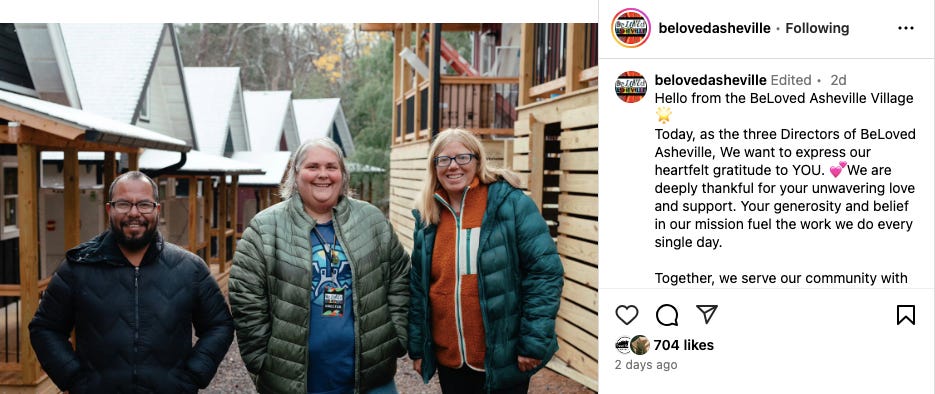
Donate to BeLoved Asheville’s mutual aid fund to secure warm and safe housing for displaced people in WNC.
I agree that focusing on smaller community efforts might be the way. At this point, it’s the only thing I feel that’s within my power at all and these days I’m taking stock of what’s already happening in my community and where I can be helpful. But also, I’ve noticed over the course of the past few months that I may have grown a little comfortable taking a “listening and learning” approach to resistance movements, and I need to work on identifying where and when I need to take the lead and be more actionable. Wish me luck.
I’m so sorry about your grandfather’s house. I imagine confirming these kinds of things after weeks of wondering, assuming, and scouring social media to identify homes via stolen wine, is a big part of why you’re not feeling happy about this shift. This is such a massive loss.
We got our first snow here, too. I wasn’t here to see it, but my best friend, who came to stay in my apartment for a writers’ retreat and motherhood getaway, did. I was in New York, learning about the wines there, wondering how I could create connectivity between the wine regions along the East Coast, as well as between the wine regions and their respective hospitality scenes. What kinds of stories can wine tell that remind us of our innate right to our homes? What role does wine play in that teaching?
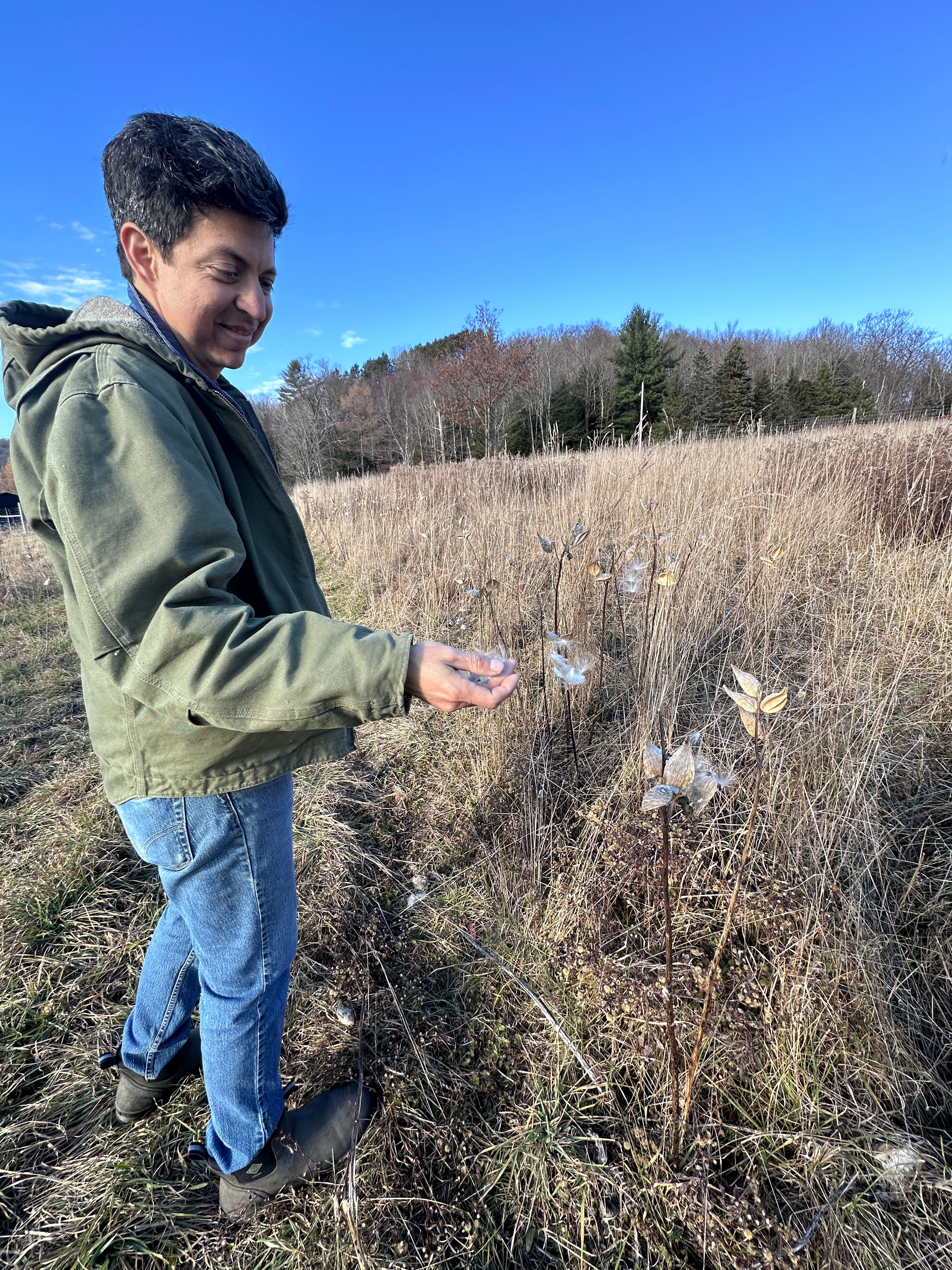
Here’s a photo from my recent travels: Alfie Alcántara of dear native grapes, admiring the milkweed that grows beside his Delaware vines in the Catskills. I had recently encountered milkweed for the first time, asked Instagram what it was, learned of its significance to the monarch population, and written a poem about it. The plant has taken on a mystical quality for me now. I’ve been trying to figure out if I want to go through the slow process of submitting it to a poetry journal (I don’t), but it feels fitting to end our letter exchange with it here, as it’s also about both of our homes.
The day before Helene I was thinking of Lebanon

We knew there would be rain
tomorrow in the Blue Ridge Mountains,
and I had seen a butterfly man online—
he taught us to scatter milkweed seeds.

I had just encountered the peculiar-shaped pods
on a trail last week, little trumpets
up to here on their stocks. Passing them by
made me feel like Alice.

Endangered monarchs need them to survive
and so it would be good for a human to encourage
growth by taking a pod just down the road
and letting the seeds go, making way for new homes.

We knew there would be rain so I returned to the trail
where two had yet to wither and brown,
brought them to the wild of my backyard
and worked the sides open with my thumb

to set the fluffy tendrils free from their cocoons.
When the wind blew, their seeds
were carried on strands of silk
across the field of goldenrod and aster:

let me at least cast this spell, let it reiterate that we are
a people who propagate homes and life and food
that we are in a state of preciousness
that we want the butterflies
I can’t wait to see Beirut one day. Maybe we’ll share a meal!
With love & potions,
Kara
"You said you wouldn’t necessarily feel happy when/if the ceasefire was agreed on; that makes a lot of sense to me. "
G'ahd reading that line knowing that Israel immediately violated the ceasefire is gut wrenching.