


The oldest grapevine in North America is a 400+ year old Muscadine known as the Mother Vine, and it lives on Roanoke Island between the mainland of North Carolina and the Outer Banks. This is also the place of early English military expeditions to Indigenous land, and it’s where Virginia Dare, the first English child born on North American soil, was last seen in 1587. She and her mother, Eleanor Dare, were two of 117 people known as the Lost Colony, and the mystery of what happened to them and what brought them there has been bound to the lore of the Mother Vine by local historians, artists, and even wine producers.
Why? Even though the vine is dated to around the time the Lost Colony arrived, it’s not clear that they cultivated the vine. Roanoke Island was inhabited and cultivated by coastal, native tribes whose presence in the area dates to 14000 B.C. On the week of July 4th, I drove down Route 64 to visit the Mother Vine to try and make sense of the narrative connection. I brought with me my favorite witch to travel with, my friend Kennedy, and my BIL (best-friend-in-law), Emily.
We maneuver beach chairs, towels, snacks, wine, books, and journals into our car and drive through the North Carolina backcountry. Past 18th-century churches, flowering tobacco plants, and a nauseating number of American flags—some of them turned upside down—a reminder that it’s the week of July 4th. Finally, we begin to taste the salt of the Atlantic, where Tropical Storm Chantel is bringing her brew to a simmer. We pull over at the Scuppernong River, my first sign of local wine history, and walk along its boardwalk under the shade of old-growth cypress trees.
On the beach, sand is lifted like a blanket being shaken out. It pelts our skin and swirls annoyingly around our faces. The wind heaves our umbrella out of the sand and throws it into the ocean, and I go screaming behind it as our neighbors watch from their beach chairs. The rain and lightning come, we run in; it goes, we run out. We spend a stormy afternoon thrifting, and in the dressing room, shirtless, my eyes land on a flyer taped to the wall reminding me that fetuses are people too, with a number to a fake pregnancy clinic. I get dressed in a hurry.
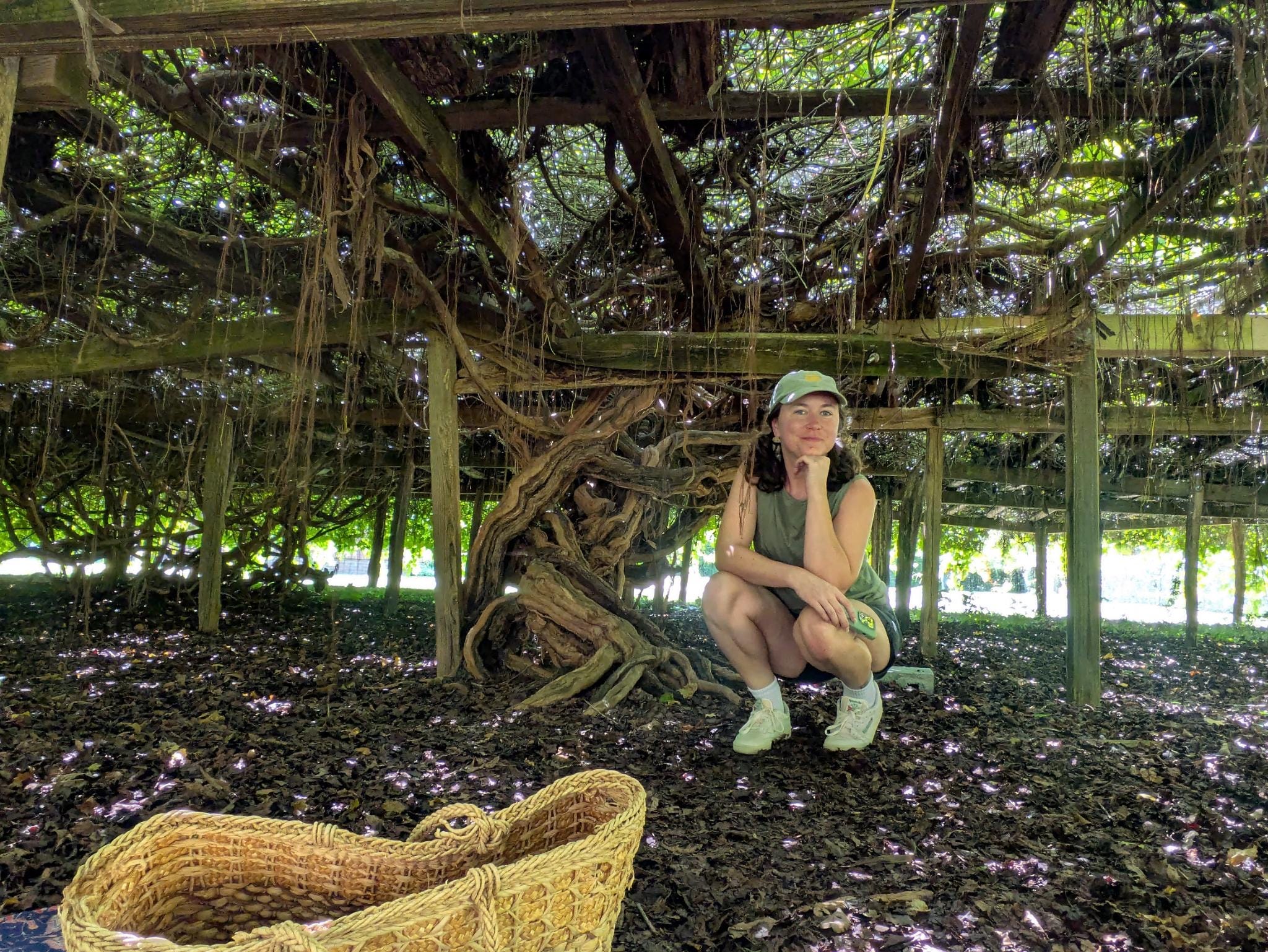
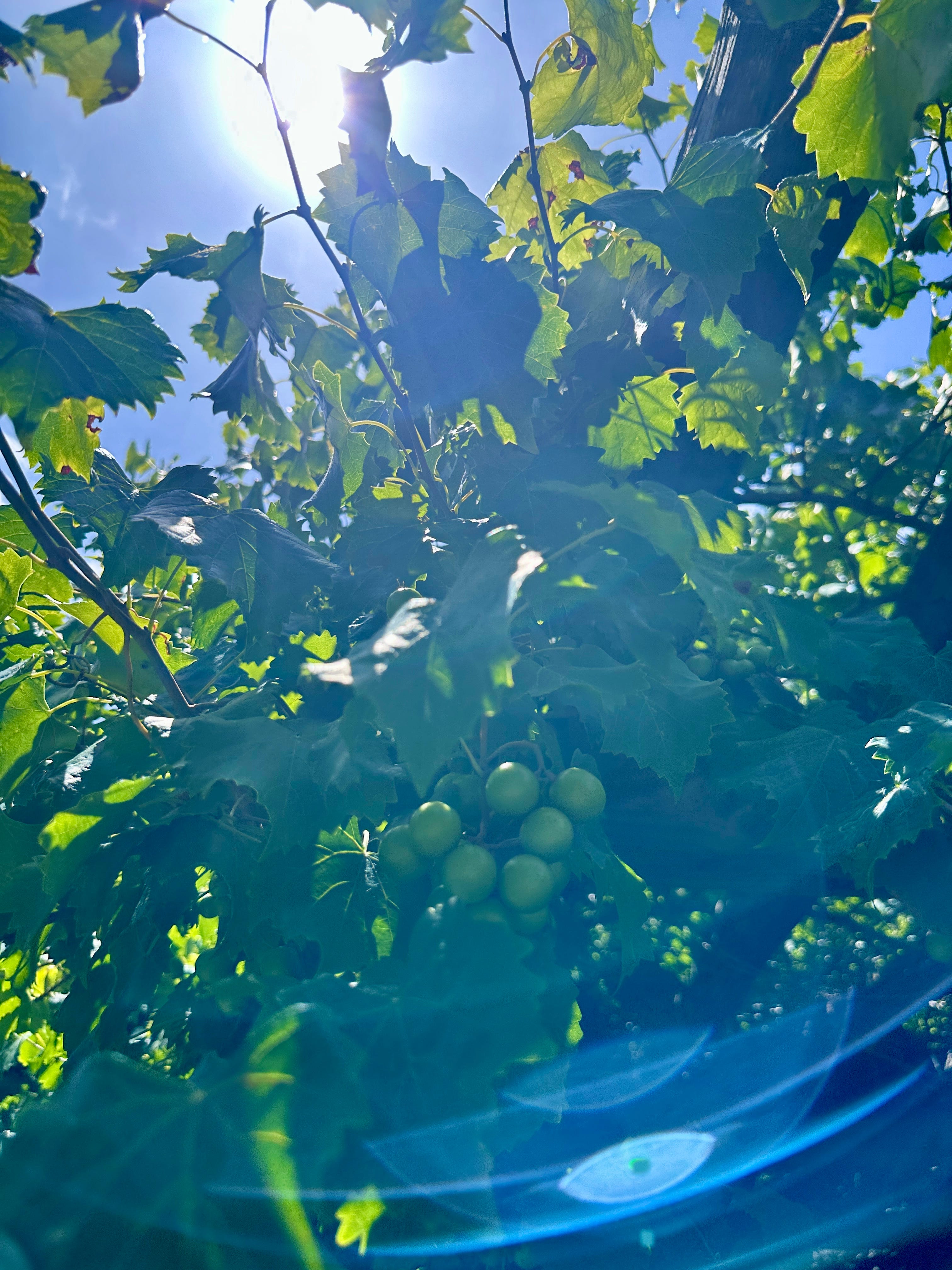
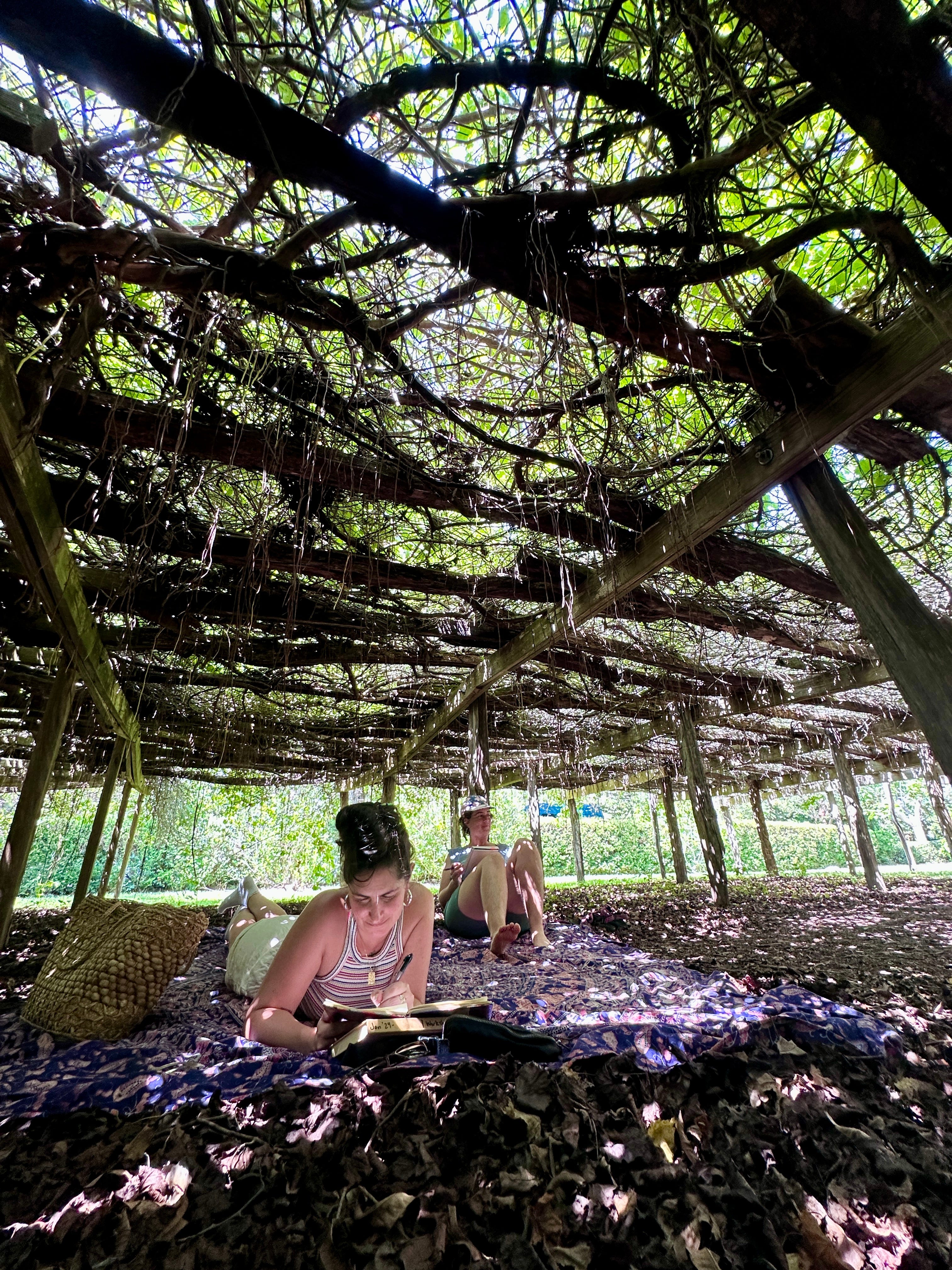
The next day is clear, wet, and hot. In the morning, we drive to the front lawn of the late Jack and Estelle Wilson, where the Mother Vine sits about 200 feet from the Roanoke Sound. We crawl under her quarter-acre canopy, supported by a massive arbor. The air is cool from the cover of foliage and hard berries not yet filled with water and color. Aerial roots stretch down, seeking ground. In the center of it all, the deeply grooved trunk twists around itself.
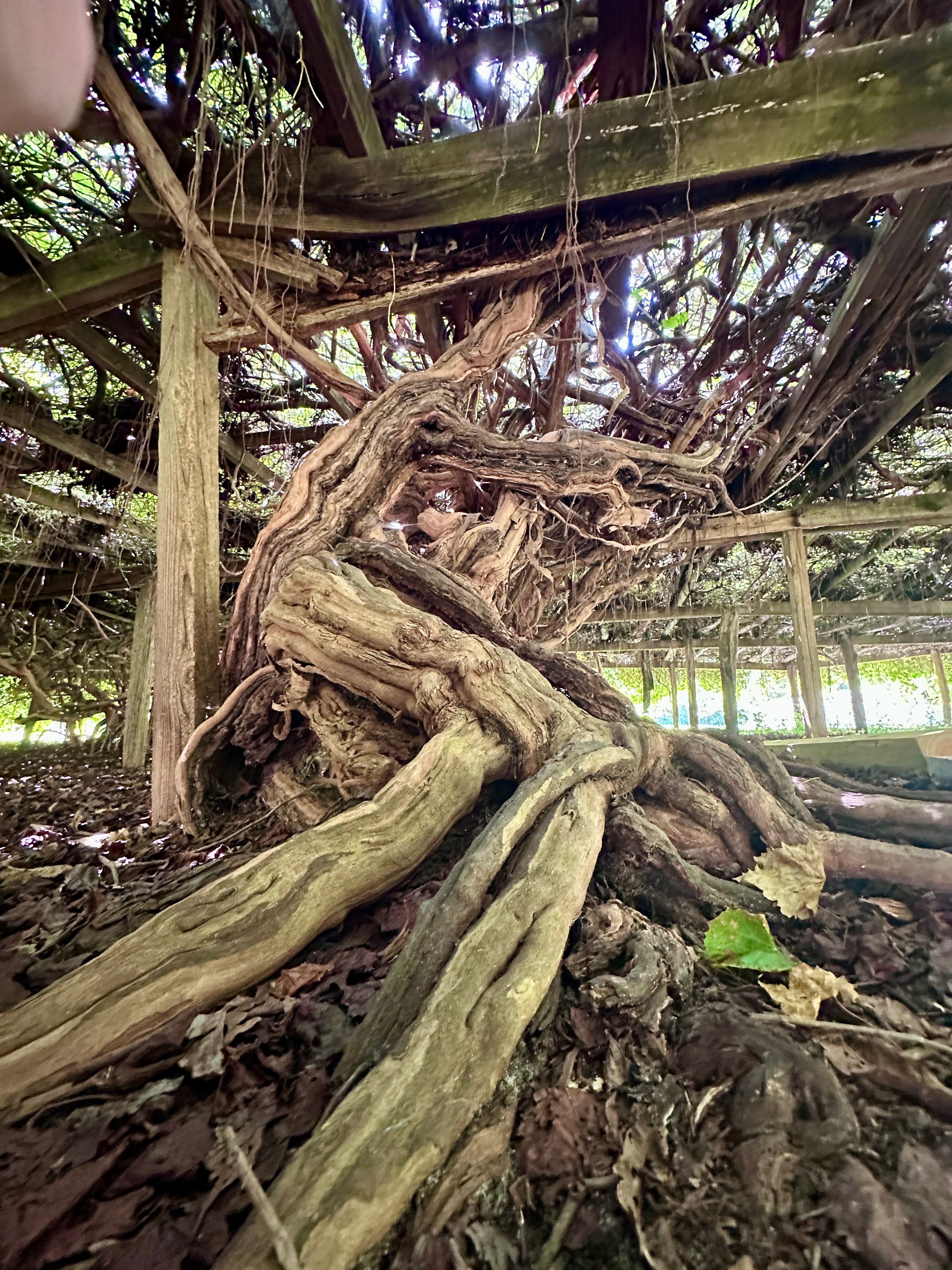
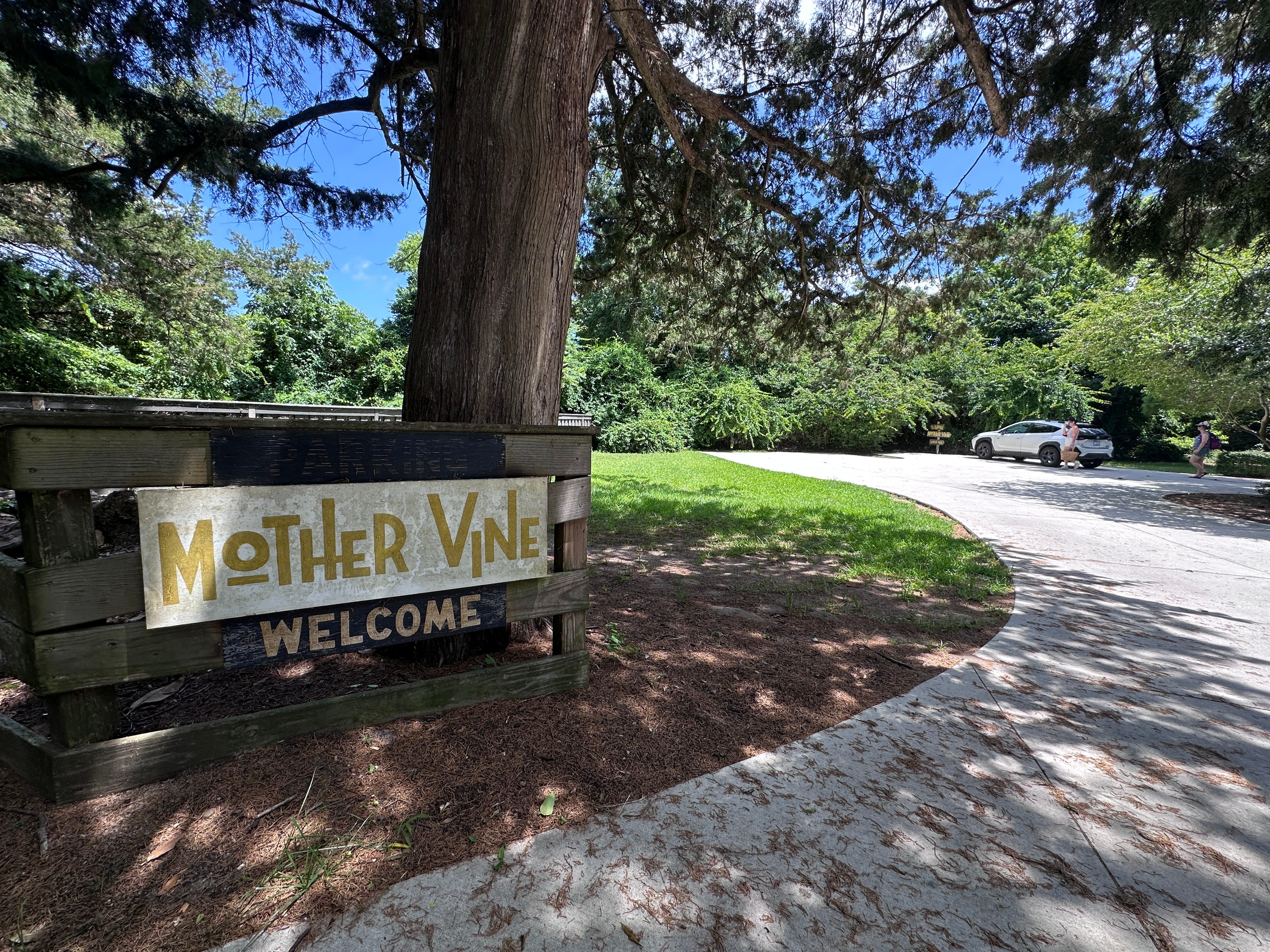
When Jack and Estelle Wilson purchased the land in 1957, the Mother Vine covered two acres, and they were undiscerning in how they cut it back to make room for their house. When they discovered they had done some damage to the vine, they brought in experts, who taught them how to prune the vine with care. In addition to committing to a lifetime of stewarding the vine, they planted a sign in their yard that reads “Mother Vine”, paved a parking area beside their driveway, and invited whoever wants to come to visit their front yard. This is a valuable teaching about what it means to be human living on land. One, that a plant’s illness or health can be an oracle, pointing to what we’re doing right or wrong. And two, if we listen, we will be transformed and so will our community.
So close to the water, the Mother Vine could have been one of those that prompted early European expeditionists to describe the land as “so full of grapes as the very beating and surge of the seas overflowed them.” This image seemed to go viral throughout Europe, prompting people like those in the Lost Colony to agree to board a ship for four months and move to a wilderness that everyone before them had died trying to get to. On one hand, this seems impossible to understand. On the other, we needn’t look further than the modern-day obsession with colonizing Mars to make it make sense.
Another viral moment for our Mother Vine: Before Prohibition, North Carolina was the most commercially successful winemaking region in the U.S. thanks to a bottle of Scuppernong (a variety of Muscadine) that fell into such high demand that the winemakers were forced to blend in bulk juice from California and New York. The bottle was named Virginia Dare, and part of the promotion of the wine was the telling of the myth of The White Doe. In this story, Virginia Dare rejects a male suitor. Seeing no other option but to curse her for rejecting him, he turns her into a depressed, white deer that roams the island. Her birth, dated and recorded on August 18, 1587, is estimated to be close to the date that the Mother Vine is aged to.
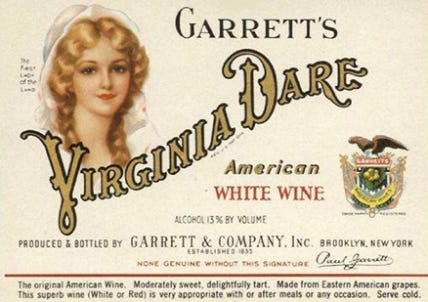
But Virginia Dare was no miracle; she was fundamental to the strategy of establishing an English colony in North America. In 1584, Queen Elizabeth commissioned her bestie, Sir Walter Raleigh, to get an English outpost established within six years. In her book, “Searching For Virginia Dare,” Marjorie Hudson writes, “the purpose of the voyage was to seal, for once and for all, Raleigh’s rights in the New World, by populating the land with English children.” Painted as a noble mission to bring Christianity and civilization to these Indigenous lands, the project instead brought disease, ethnic cleansing, and environmental degradation, the consequences of which we’re living with today. As the current administration’s aggressive attack on birthright citizenship proceeds, we can use Virginia Dare’s story to understand what being born on this land really means from a colonizer’s perspective. And as the aftermath of Roe v. Wade being overturned continues to push women towards forced birth and marriage, we might view the lore and deification of Virginia Dare through a more critical lens.
Fast forward the tape from 1587, and you’ll see a couple of centuries of not-so-lost-but-still-suffering colonies trying and failing to make wine. They didn’t have the botanical knowledge to understand that North American vines aren’t the same as European vines, and that the vines they cultivated back home would respond differently to this climate. This seems obvious today, but we can look back and witness the human capacity to wildly overestimate ourselves, to move with ignorance, and to ignore the signs that nature gives back to us. This is still going on today, and you don’t have to drive far from the Mother Vine to notice it—the signs in people’s yards leading up to Mother Vineyard Road protesting overdevelopment of the island, or the local tasting room that features European rather than local varietals.
Will we learn? Time will tell.
wow! I got to visit it one day